
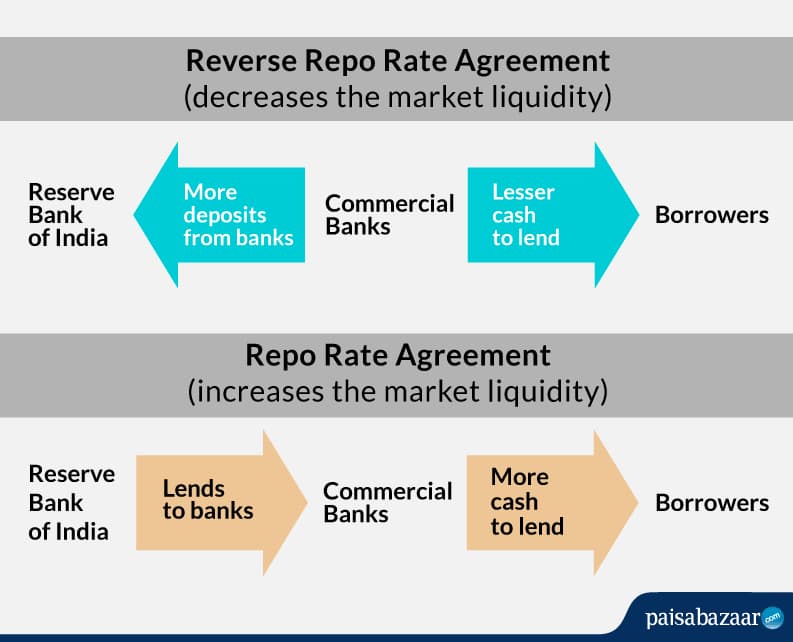
Discussing about Repo Rate & Reverse Repo Rate:
Repo Rates:
Repo rates is the rate at which the banks and financial institutions borrows money from the central bank. Here, Nepal Rastra Bank is the central bank of Nepal. It is a short term borrowings of the bank mainly to manage the shortage of funds in the bank. Generally, government bonds/liquid bonds are used as a collateral security by the bank. It is also called as a repurchase agreement or a buyback since an agreement is also made to repurchase the bonds which had been kept as the collateral security at a predetermined price. Repo Rates is one of the main tool of Nepal Rastra Bank to keep inflation under control.
If the NRB wants to make it more expensive for banks to borrow money, it increases the repo rate. Similarly, if it wants to make it cheaper for banks to borrow money, it reduces the repo rate. According to the Monetary Policy 2019-20, the repo rate is to be maintained at 4.5%.
Reverse Repo Rates
This is exactly opposite from the repo rates. Reverse repo rate is the rate at which the NRB borrows the money from the banks and financial institutions. It is always lesser than the repo rates. Banks parks their excess funds in the NRB since it is absolutely risk free.
When the NRB increases the rate of reverse repo, RBI will borrow the money from the banks.
How it controls the inflation and money flow?
When the NRB increases the repo rates, there will be the less availability of loans to the banks. Due to the high costs of borrowing restricts money supply for furthering economic activity.
Moreover, when the rate of reverse repo is increased by the NRB, banks would park the excess funds in the NRB being the risk free investment. Due to this, banks have less money to lend to the customers and hence the flow of money through the customer would decrease. Inflation simply means a decrease in the purchasing power of a nation’s currency. The increment in the reverse repo rate plays a great role in controlling the inflation as well.
Examples:
Repo Rates: Broadly speaking, if the repo rate fixed by the NRB is 4.5% and the money borrowed by the bank is Rs.50 Crore, then the interest paid to the NRB will be calculated at Rs. 4.5 Crore on an annual basis.
It is exactly opposite in the case of Reverse Repo.
Thank You!
We will be updating these kind of information, please be in touch with https://cangaassociates.com/news