
For anyone managing a technical team or scaling a production-grade technology ecosystem in Nepal, the hardest operational challenge isn't architecting asynchronous microservices or managing database state—it is retaining top-tier engineering talent.
The government’s April 2026 Economic Status Paper lays out the exact scale of the human capital flight we are up against. While the macroeconomic numbers reflect the broader workforce, the underlying trend represents the single greatest existential threat to building enterprise software in the country.
The Scale of the Exodus
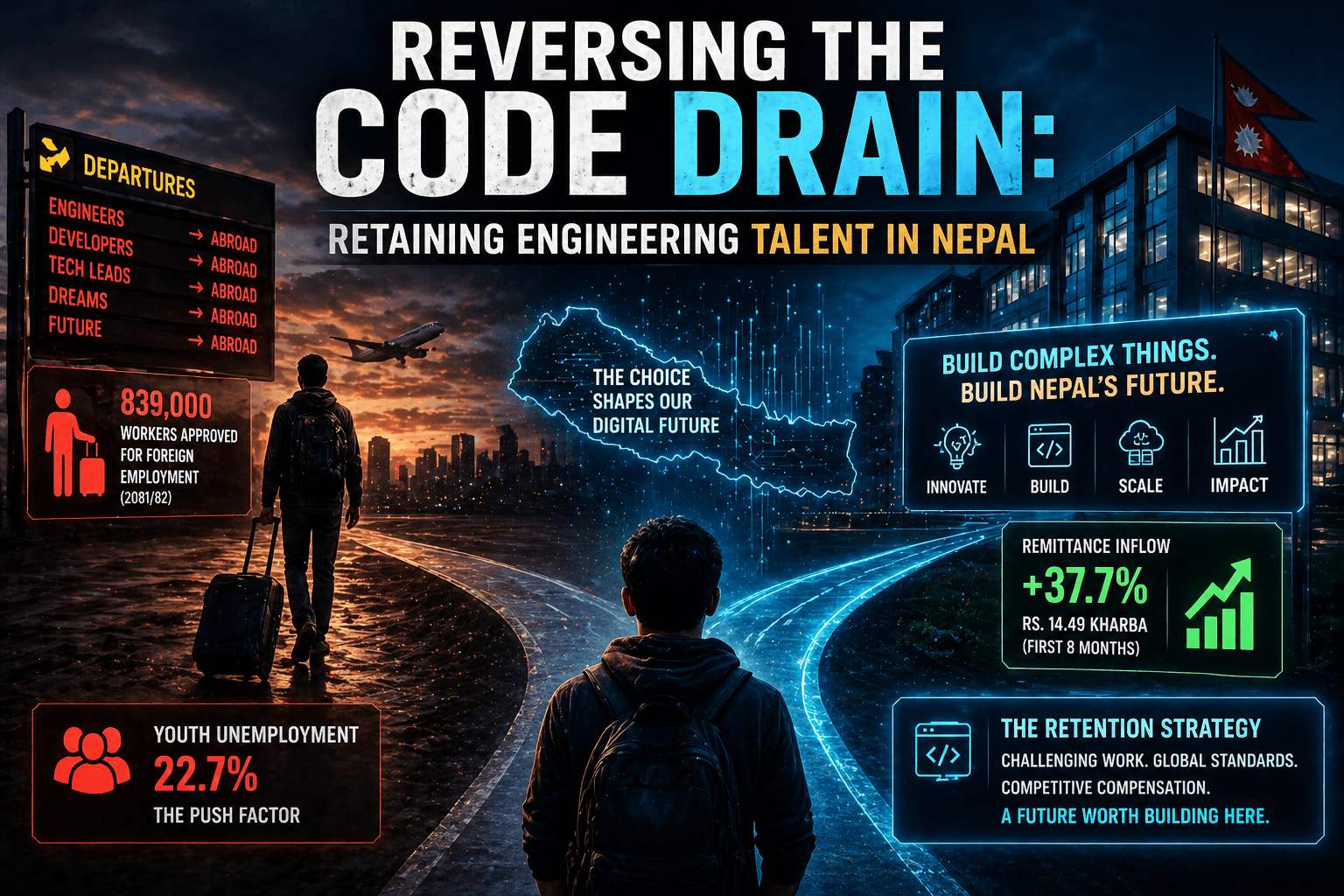
The national data is sobering. While the overall unemployment rate stands at 12.6% , the youth unemployment rate (ages 15-24) sits at a critical 22.7%. Driven by a lack of dignified, high-value opportunities at home, the workforce is leaving at an unprecedented volume.
In the fiscal year 2081/82 alone, a staggering 839,000 Nepali workers received labor approvals (506,000 new and 333,000 renewed) for foreign employment. While many of these are traditional labor roles, the tech sector feels this drain acutely as mid-level and senior engineers constantly migrate to North America, Europe, or the Middle East for better compensation and professional growth.
The Remittance Trap
From a purely macroeconomic standpoint, this exodus keeps the national accounts afloat. In just the first eight months of the current fiscal year, remittance inflows surged by 37.7% to hit Rs. 14.49 Kharba.
However, the status paper rightfully identifies the long-term risk of this reliance: while remittance provides short-term economic relief, it leads to a severe shortage of skilled human capital domestically and risks the long-term degradation of the nation's workforce. For a technology company trying to build complex, high-performance backend architectures, competing against this outward pull is incredibly difficult when the domestic talent pool is constantly shrinking.
The Retention Strategy: Build Complex Things
The government explicitly states the need to create adequate employment opportunities at home to end the compulsion of forced foreign employment. But government policy won't keep a senior DevOps engineer or an AI specialist in Nepal—challenging, highly scalable work will.
To reverse the code drain, tech founders must pivot from building simple boilerplate applications to developing highly complex, production-grade enterprise ecosystems. Engineers stay when they are intellectually challenged. When local companies build localized large language models, highly concurrent video streaming architectures, or sophisticated fintech platforms, they create the exact type of high-value, dignified roles that rival foreign opportunities.
Retaining talent requires paying competitive rates, but more importantly, it requires building software that demands an elite level of engineering.