
For software engineers and product founders, user behavior is the ultimate arbiter of what we build. You can design the most elegant user interface or deploy the most sophisticated machine learning algorithms, but if your platform doesn't seamlessly handle how users want to move their money, adoption will flatline.
The April 2026 Economic Status Paper confirms a permanent, structural shift in the Nepali economy: the era of cash dominance is ending. For anyone building software today, integrating robust, secure, and instantaneous digital payment infrastructure is no longer a premium feature—it is the baseline expectation.
The Data: A High-Throughput Reality
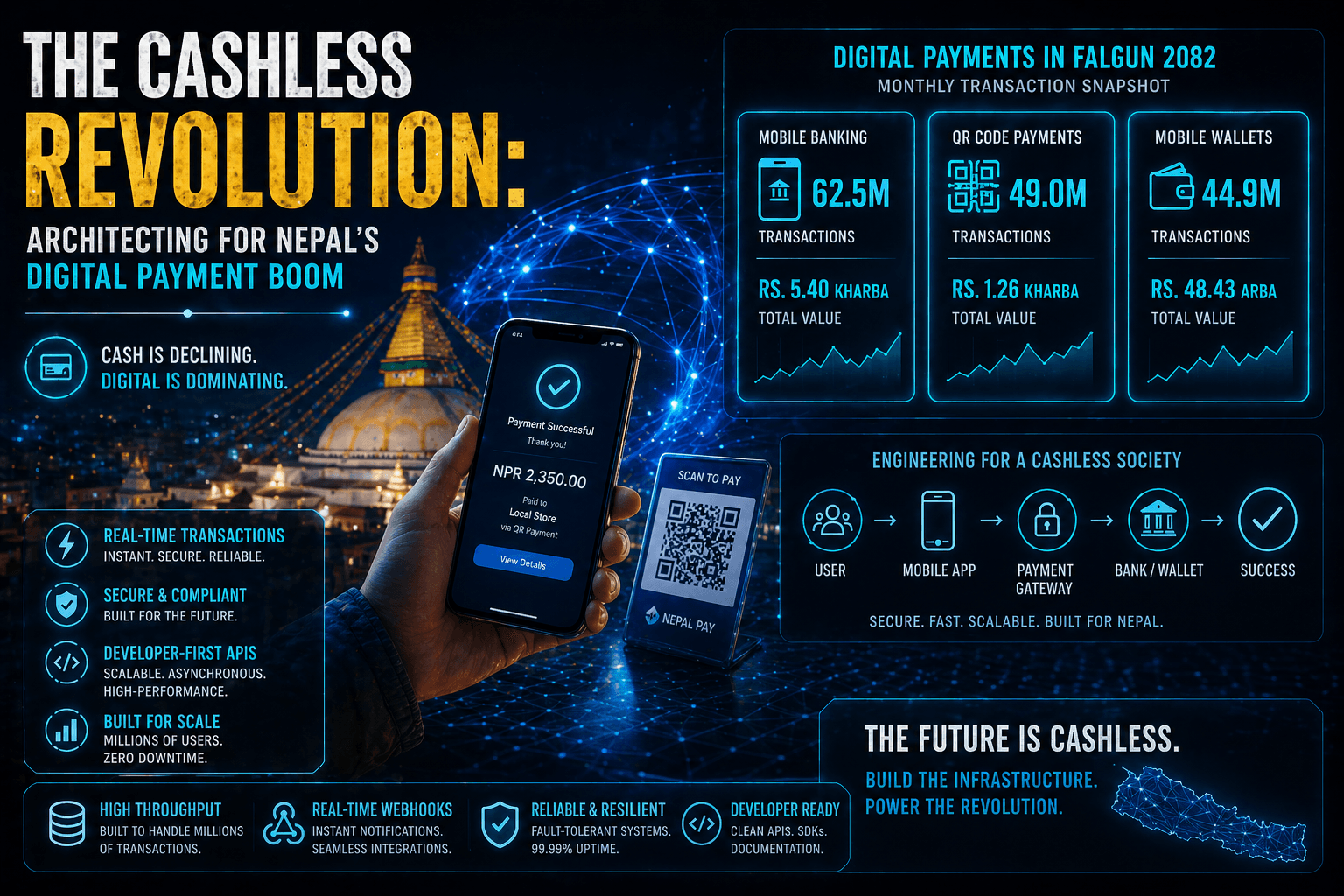
The scale of digital adoption post-COVID-19 is staggering. The status paper provides a snapshot of transaction volumes from a single month (Falgun 2082), and the numbers dictate serious architectural considerations for any tech company:
- Mobile Banking: Facilitated 62.5 million transactions, moving a massive Rs. 5.40 Kharba.
- QR Code Payments: Drove 49.0 million transactions, processing Rs. 1.26 Kharba.
- Mobile Wallets: Handled 44.9 million transactions, totaling Rs. 48.43 Arba.
When millions of users are transacting across mobile apps and QR networks simultaneously, the tolerance for system latency or downtime drops to zero.
The Engineering Imperative
What does this macroeconomic data mean for your codebase? It means that building "toy" payment integrations will not survive in the wild.
Handling this level of transaction throughput requires production-grade backend architectures. If you are building platforms like streaming services, SaaS CRMs, or local digital exchanges, your APIs must be built to handle massive concurrency. This necessitates moving away from blocking, synchronous code and embracing highly optimized, asynchronous frameworks paired with robust relational databases. You must design systems that can handle real-time webhook updates for QR payments, manage complex state transitions during network timeouts, and absolutely prevent race conditions in user wallets.
Preparing for a Cashless Society
The government's stated goal is to build a secure and robust cashless society. As physical cash transactions dwindle, the tech companies that provide the most frictionless, secure, and reliable payment experiences will capture the market.
Whether you are building B2B enterprise software that needs to automate invoicing and reconciliations, or consumer-facing apps requiring micropayments, your financial infrastructure must be bulletproof. The money is moving digitally; as builders, our job is to ensure the pipes don't leak